
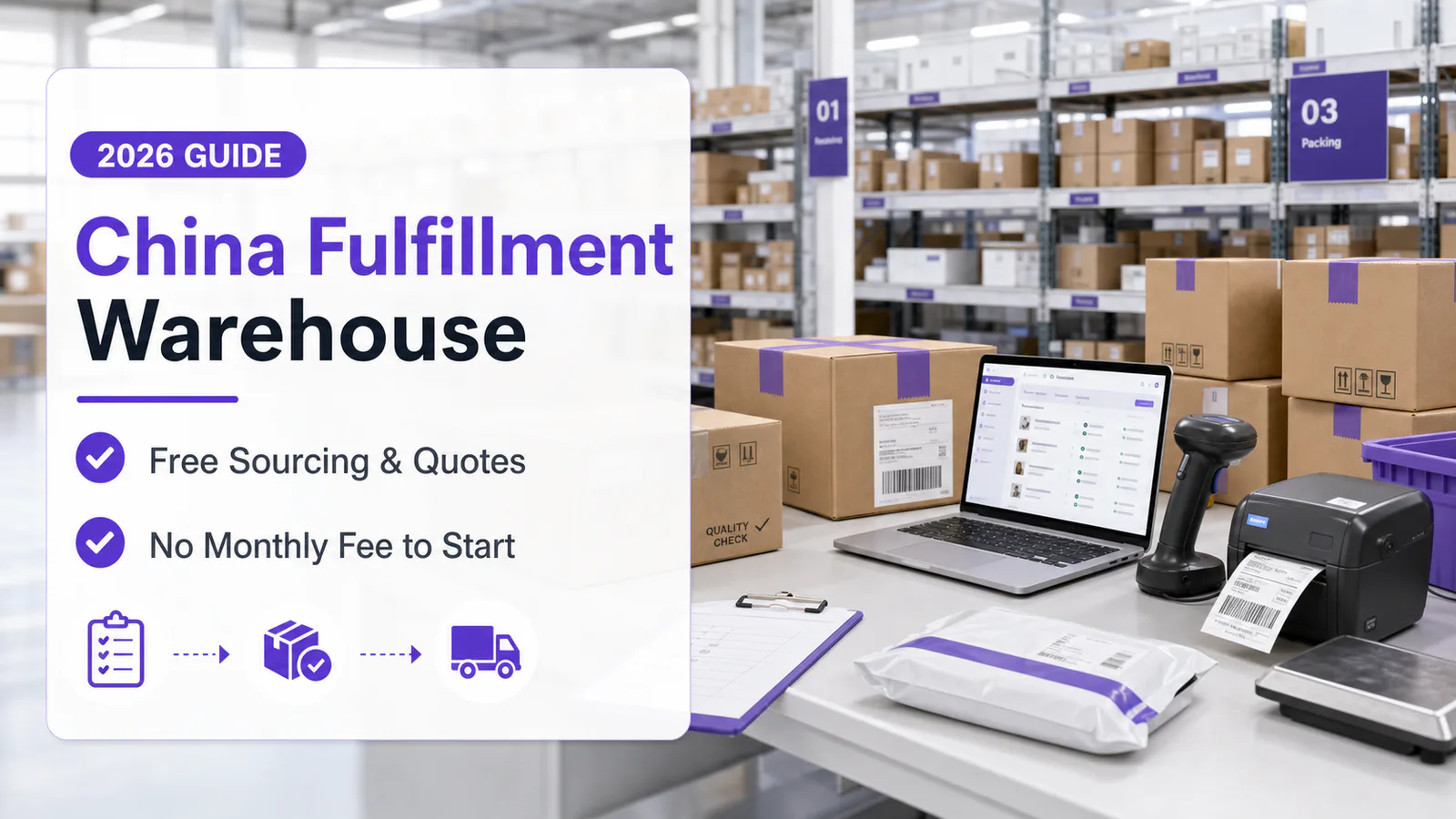
Ecommerce sellers often search for a free fulfillment warehouse because they want to test a product without paying a subscription before the first order ships. The phrase sounds simple, but warehouse pricing is rarely simple. Storage, receiving, quality checks, packaging, pick and pack, and international shipping all create real operating costs.
Shiplox uses a clear service-fee model: sourcing requests are free and unlimited, and sourcing, basic QC, receiving, storage, Shopify sync, and fulfillment service have a $0 Shiplox fee. You review the product, shipping, packaging, customs or duties, returns, reships, and any product-specific third-party costs before approval.
Quick answer: is the Shiplox fulfillment warehouse free?
With Shiplox, warehouse receiving, storage, basic QC, pick and pack, Shopify sync, and fulfillment service have a $0 Shiplox fee. Sellers pay for products or samples, supplier transport, packaging materials, international shipping, customs or duties, returns, reships, and any agreed product-specific third-party cost.
The practical offer is $0 for Shiplox services, with physical and third-party costs quoted before approval. Every account also gets a private agent who can coordinate sourcing, QC, warehouse work, and fulfillment seven days a week.
| $0 Shiplox services | Costs the seller still pays |
|---|---|
| Unlimited product sourcing requests | Product or sample cost |
| Supplier comparison, quotes, and basic MOQ review | Supplier-to-warehouse and international shipping |
| Basic QC, warehouse receiving, and storage | Packaging materials and customization |
| Shopify sync, pick and pack, and fulfillment service | Customs or duties, returns, and reships |
| Private agent access seven days a week | Product-specific third-party or exceptional costs agreed in advance |
| No monthly subscription | Only costs the seller approves |
The exact paid items depend on the product, destination, order volume, packaging, and requested service. A quote should show those items clearly before you approve them.
What does a free fulfillment warehouse actually mean?
In ecommerce, a free fulfillment warehouse often means that only one or more entry costs are removed. It may mean no account-opening fee, free onboarding, a product quote, or a limited storage allowance. Shiplox uses the term more specifically: its receiving, storage, basic QC, pick-and-pack, store-sync, and fulfillment service fees are $0, while physical goods and third-party costs remain payable.
Shiplox uses "free" for the Shiplox-operated services it provides at a $0 service fee. The paid portion begins when you approve a product or sample, supplier transport, packaging material, carrier shipment, customs or duties, return, reship, or another product-specific third-party cost.
This distinction matters. A seller comparing fulfillment partners should ask which exact line items are free, for how long, and under what conditions. A vague promise can hide costs inside the unit price or shipping rate. A clear quote makes the business model easier to evaluate.
What is order fulfillment?
Order fulfillment is the work required to prepare and send a customer's order after the order is placed. It commonly includes locating the correct SKU, confirming the quantity and variant, packing the parcel, creating a shipping label, handing it to a carrier, and returning tracking information to the store.
Shopify's fulfillment documentation describes fulfillment as preparing, packing, and shipping items to customers, either by the merchant or through a fulfillment service. A China fulfillment warehouse adds an earlier supply-chain layer because stock can move from nearby Chinese suppliers into the warehouse before individual customer orders are shipped worldwide.
For an ecommerce seller, the full workflow can include sourcing, samples, supplier coordination, warehouse intake, quality checks, inventory, pick and pack, custom packaging, international shipping, tracking, and exception handling.
Why use a fulfillment warehouse in China?
A China fulfillment warehouse can make sense when products are manufactured or sourced in China and customers are spread across several countries. Instead of sending a bulk shipment to one destination before any customer buys, approved stock can move from suppliers to a China warehouse and then ship as individual orders or planned bulk transfers.
The main operational advantage is consolidation. Products from one or more suppliers can enter one controlled workflow for counting, SKU identification, packaging, and dispatch. That can reduce the number of separate supplier conversations a seller manages and make it easier to use consistent packaging and tracking processes.
The model is not automatically the cheapest for every product. Heavy, oversized, fragile, regulated, liquid, battery-powered, or very low-margin products may be poor candidates for parcel fulfillment from China. The right decision depends on packed dimensions, actual weight, destination, route, return risk, and customer delivery expectations.
Read the broader China warehouse for ecommerce guide before deciding where to hold inventory.
What Shiplox includes before you pay
Shiplox is designed to let sellers investigate a product and its fulfillment path before making a purchasing decision.
Free product sourcing requests
You can submit a product link, photo, screenshot, product name, competitor reference, or specification. The sourcing request gives the team a concrete item to check. Clear requests produce better quotes, so include the destination country, expected order volume, preferred variants, target retail price, and packaging needs.
Free initial quote preparation
The initial quote can outline the available product path, estimated unit cost, MOQ, sample option, lead time, packed size or weight when available, and possible shipping or fulfillment approach. A quote is an estimate until the final product, quantity, packaging, destination, and route are confirmed.
No monthly subscription to start
Shiplox does not require a monthly subscription simply to submit sourcing requests or access the starting workflow. This is useful for a seller testing one SKU and for a growing store that regularly evaluates new products.
A connected sourcing and fulfillment plan
The quote can consider more than the supplier price. It can connect the product to warehouse intake, quality checks, packaging, pick and pack, shipping, and tracking. That helps reveal whether a product that looks cheap at the factory still works after the full landed and fulfillment cost is considered.
For a sourcing-first explanation, see the free China sourcing agent guide.
Which fulfillment warehouse costs remain payable?
Participating manufacturers fund product discovery and placement on Shiplox. That funding covers Shiplox warehouse labor and service fees for sellers. The quote identifies the physical goods and third-party costs that still apply so the seller can approve them before spending.
| Cost layer | Shiplox fee | What the seller pays for |
|---|---|---|
| Product or sample | $0 sourcing fee | Goods purchased from the supplier |
| Supplier-to-warehouse transport | $0 coordination fee | The carrier or supplier transport charge |
| Warehouse receiving | $0 | No Shiplox receiving charge |
| Basic quality check | $0 | No basic-QC charge; specialized testing may require an agreed third party |
| Storage | $0 | No Shiplox storage charge for supported active sellers |
| Pick and pack | $0 | No Shiplox fulfillment-service charge |
| Packaging | $0 handling fee | Mailers, boxes, inserts, labels, or custom materials |
| International shipping | $0 coordination fee | The carrier charge for the selected route |
| Exceptions | $0 standard service fee | Return transport, reships, replacement goods, duties, or agreed third-party work |
Not every order uses every line. For example, a product shipped in its supplier packaging may not need custom packaging, while a bundle made from multiple suppliers may require consolidation and extra handling.
How does the Shiplox warehouse workflow operate?
The following workflow shows how a normal ecommerce product can move from an idea to a delivered order. The exact sequence can change for custom products, preorders, regulated goods, or bulk shipments.
1. Send the product reference
The seller submits a product link, image, or specification and identifies the intended market. Useful details include desired material, color, size, quantity, target retail price, estimated monthly orders, selling platform, and packaging preference. This first step is free and gives the sourcing team enough context to avoid quoting the wrong item.
2. Review supplier and product options
The sourcing team checks possible supplier matches, MOQ, lead time, variants, sample availability, and obvious sourcing risks. The goal is not simply to find the lowest unit price. The goal is to find a product path that can be sampled, checked, packed, and shipped with a sensible total cost.
3. Review the quote before approval
The seller reviews the quote and decides whether to skip the product, request a sample, or approve an order. Product price should be considered together with domestic China transport, packaging materials, international shipping, customs or duties, payment fees, advertising cost, and expected returns. Shiplox sourcing, basic QC, receiving, storage, Shopify sync, and fulfillment service remain $0.
4. Approve a sample or stock order
When a sample is appropriate, it lets the seller review material, size, color, function, packaging, and customer-facing quality before buying more. Some simple, low-risk products may follow a different approval path, but skipping validation only to save time can create larger costs later.
5. Receive stock at the China warehouse
Approved goods move from the supplier to the warehouse. The team records the inbound cartons or units and associates them with the correct SKU or request. Products from multiple suppliers may be consolidated when the scope and packaging plan support it.
6. Check and prepare inventory
The warehouse follows the approved intake or quality-check scope. This may include quantity checks, visible condition, variant confirmation, basic function checks, photos, relabeling, inserts, or custom packaging. A warehouse check reduces risk but does not replace required laboratory testing, certification, or a formal factory audit.
7. Pick, pack, and ship orders
When an order is ready for fulfillment, the warehouse selects the correct SKU and variant, prepares the parcel, applies the shipping label, and hands it to the selected route or carrier. Packaging choices should protect the product without adding unnecessary dimensional weight.
8. Return tracking and handle exceptions
Tracking information should return to the seller's store or dashboard so the customer can follow the parcel. Address problems, carrier delays, lost parcels, damaged shipments, returns, and reships need a documented support path because fulfillment is not complete when a label is printed.
The complete operating model is covered in China ecommerce fulfillment for 2026.
How does Shopify fulfillment from China work?
A Shopify store can use a third-party fulfillment service to store inventory and ship orders. Shopify explains that fulfillment services can receive order information and handle storage, packing, and shipping, while app-based integrations can return status updates to the Shopify admin. See Shopify's official guide to setting up order fulfillment.
The operational setup should answer five questions:
- Which Shopify products are assigned to the China warehouse?
- How are SKUs and variants matched between the store and warehouse?
- When is an order released for fulfillment?
- How is tracking returned to Shopify?
- What happens when stock is missing, an address is invalid, or an order changes?
Inventory accuracy matters because a store should not sell a variant that the assigned fulfillment location cannot ship. Shopify's documentation on fulfillable inventory explains how inventory availability and shipping zones affect whether customers can complete checkout.
For setup details, read Shopify fulfillment from China and the complete Shopify fulfillment guide.
Is no-monthly-fee fulfillment cheaper?
No monthly fee does not automatically make the physical supply chain free. Shiplox removes its service fees, while the seller still pays the supplier, carriers, packaging providers, customs authorities, and other approved third parties.
Compare providers using total cost for the same product and order profile:
Product cost + China transport + packaging materials + international shipping + customs/duties + payment fees + return allowance + $0 Shiplox service fees = estimated fulfilled cost
Then compare service quality, delivery range, tracking, support, and exception handling. A lower quote is not a better quote if it excludes important cost layers or uses a route that does not match customer expectations.
Use the Shiplox pricing page to understand the approval-based model and the shipping calculator for early route planning.
Free-to-start warehouse vs other fulfillment models
| Model | Upfront commitment | Best suited to | Main tradeoff |
|---|---|---|---|
| Shiplox $0-service-fee workflow | No Shiplox fee for sourcing, basic QC, receiving, storage, store sync, or fulfillment | Sellers testing or scaling China-sourced products | Products and third-party costs still require approval and payment |
| Traditional subscription 3PL | Monthly account or software cost may apply | Stable volume and established inventory | Fixed costs can continue during slow months |
| Marketplace supplier fulfillment | Often no warehouse subscription | Very early product testing | Less control over quality, packaging, inventory, and tracking |
| Self-fulfillment | No third-party warehouse account | Small local order volume | Seller handles space, labor, labels, carrier handoff, and returns |
| Bulk import to a local 3PL | Freight and inventory commitment before sales | Proven products with concentrated demand | More inventory cash is committed before customer orders arrive |
The best model depends on order volume, destination mix, product size, return rate, desired delivery speed, packaging needs, and the seller's capacity to manage operations.
Who is a good fit for this model?
A free-to-start China fulfillment workflow can be useful for:
- Shopify, TikTok Shop, WooCommerce, Amazon, Etsy, and custom-store sellers
- Sellers testing a specific product before buying more inventory
- Stores that source several SKUs from China
- Brands that need supplier coordination and fulfillment in one workflow
- Sellers that want custom labels, inserts, mailers, or boxes
- Teams that do not want another monthly subscription before product approval
- Stores shipping to several countries from one China inventory point
The model is strongest when products are reasonably lightweight, legal to sell and ship, easy to identify by SKU, and valuable enough to support international fulfillment costs.
Who may need a different warehouse plan?
This model may not be the best first choice when the product is oversized, extremely heavy, highly fragile, temperature-sensitive, dangerous, counterfeit, restricted, or subject to complex destination-country rules. Food, supplements, cosmetics, medical products, liquids, magnets, batteries, and electronics may require additional documents, testing, packaging, or shipping controls.
High-volume sellers with stable demand in one country may also benefit from comparing China parcel fulfillment with bulk freight into a regional warehouse. A hybrid plan can hold test inventory in China and move proven SKUs closer to customers when order density supports it.
Shiplox should be used as an operating partner, not as a substitute for legal, tax, customs, product-safety, or certification advice. The seller remains responsible for confirming that a product can legally be imported and sold in the target market.
What should you send for a free fulfillment quote?
Send one focused request with enough detail to estimate the real workflow:
- Product link, photo, or specification
- Target destination country or countries
- Expected orders per month
- Product quantity and variants
- Target retail price
- Desired delivery expectation
- Current supplier details, if available
- Packaging requirements
- Selling platform
- Any known battery, liquid, magnet, food-contact, cosmetic, or safety issue
Use this message template:
I need a China fulfillment quote for this product.

Product link or photo:
Target country:
Expected monthly orders:
Product quantity and variants:
Target retail price:
Packaging requirements:
Selling platform:
Current supplier, if any:

Please show the product, warehouse, packaging, and shipping cost layers separately.
A complete request helps the team quote the correct product and route. A message that only says "How much is fulfillment?" cannot produce a reliable answer because fulfillment cost depends on the physical parcel and destination.
How can you evaluate the quote?
Use this checklist before approving a sample, stock order, or shipment:
| Question | What a useful answer contains |
|---|---|
| What exactly is free? | The free request, quote, access, or onboarding item is named |
| What triggers payment? | Clear approval point for products or services |
| What is the packed size and weight? | Dimensions and weight used for shipping planning |
| Which warehouse tasks are included? | Receiving, checking, storage, picking, packing, and labeling scope |
| Which shipping route is quoted? | Destination, tracking, delivery range, and restrictions |
| What is not included? | Taxes, duties, returns, reships, custom work, or other exclusions |
| How are variants controlled? | SKU, barcode, label, or bin process |
| How are problems handled? | Contact path for shortage, damage, delay, return, or lost parcel |
Do not compare only the product price. Compare the fulfilled cost, the service scope, and the operational risk.
Why Shiplox connects sourcing and fulfillment
Product sourcing and fulfillment affect each other. The supplier determines unit cost, lead time, packaging, carton size, and product consistency. The warehouse determines how the product is received, checked, stored, packed, and dispatched. The shipping route determines delivery expectations, tracking, restrictions, and a major part of the final cost.
When those parts are managed separately, a seller may approve a low supplier price before discovering that the parcel is too large, the packaging is weak, the product needs relabeling, or the route is unsuitable. Shiplox connects the decisions so the seller can review a more complete path before scaling the product.
Shiplox can help with product sourcing, supplier comparison, sample coordination, warehouse intake, agreed quality checks, storage, pick and pack, custom packaging, international shipping, and tracking. Start with a free product request, review the quote, and approve only the physical goods and third-party costs that make sense for the store.
Common questions about free fulfillment warehouses
Can I use the Shiplox warehouse without a monthly fee?
Yes. Shiplox does not require a monthly subscription. Sourcing, basic QC, receiving, storage, Shopify sync, and fulfillment service have a $0 Shiplox fee. You pay for approved products, shipping, packaging materials, customs or duties, returns, reships, and product-specific third-party costs.
Is warehouse storage completely free?
Shiplox warehouse storage has a $0 service fee. There is no short free-trial cutoff: the team can continue supporting active sellers whose orders move slowly. Product-specific storage conditions, restricted goods, unusually large inventory, or exceptional requirements should still be confirmed with the seller's private agent before stock is sent.
Are pick and pack and international shipping free?
Shiplox pick-and-pack and fulfillment service have a $0 fee. Packaging materials and international carrier shipping are paid costs; their amount depends on the parcel, destination, route, and approved packaging.
Can Shiplox fulfill orders from my existing supplier?
The workflow can support products from an existing supplier when the product, supplier handoff, warehouse intake, and shipping requirements are workable. Send the supplier and product details so the team can review the operational path.
Can I use Shiplox for Shopify fulfillment?
Yes, Shiplox supports ecommerce fulfillment workflows for Shopify sellers. Product and variant mapping, inventory availability, order release, shipment status, and tracking should be confirmed during setup so the store and warehouse use the same data.
Can the warehouse add custom packaging?
Custom mailers, boxes, labels, cards, inserts, bundles, and other packaging may be possible depending on design, material, MOQ, lead time, and product dimensions. Sellers pay for the packaging materials or supplier production cost; Shiplox does not add a fulfillment-service fee. Packaging should be sampled before a large order when appearance or fit is important.
Does a warehouse check guarantee that every product is defect-free?
No. An agreed warehouse check can reduce visible mistakes, wrong variants, quantity problems, and selected functional risks, but it cannot guarantee zero defects. It also does not replace required compliance testing, certification, factory audits, or legal review.
Sources and methodology
This guide was prepared by the Shiplox sourcing and fulfillment team and last reviewed on July 25, 2026. Shiplox service statements reflect its current $0-service-fee model. Products, samples, transport, packaging, customs or duties, returns, reships, and product-specific third-party costs remain subject to the approved quote and operational scope.
External references used for fulfillment definitions and platform workflow:
- Shopify Help Center: Fulfilling orders
- Shopify Help Center: Setting up order fulfillment
- Shopify Help Center: Setting up fulfillable inventory
Service terms, carrier routes, costs, and platform behavior can change. Confirm current details for the product, destination, and selling channel before approval.